Off the Road Again Sean Walsh
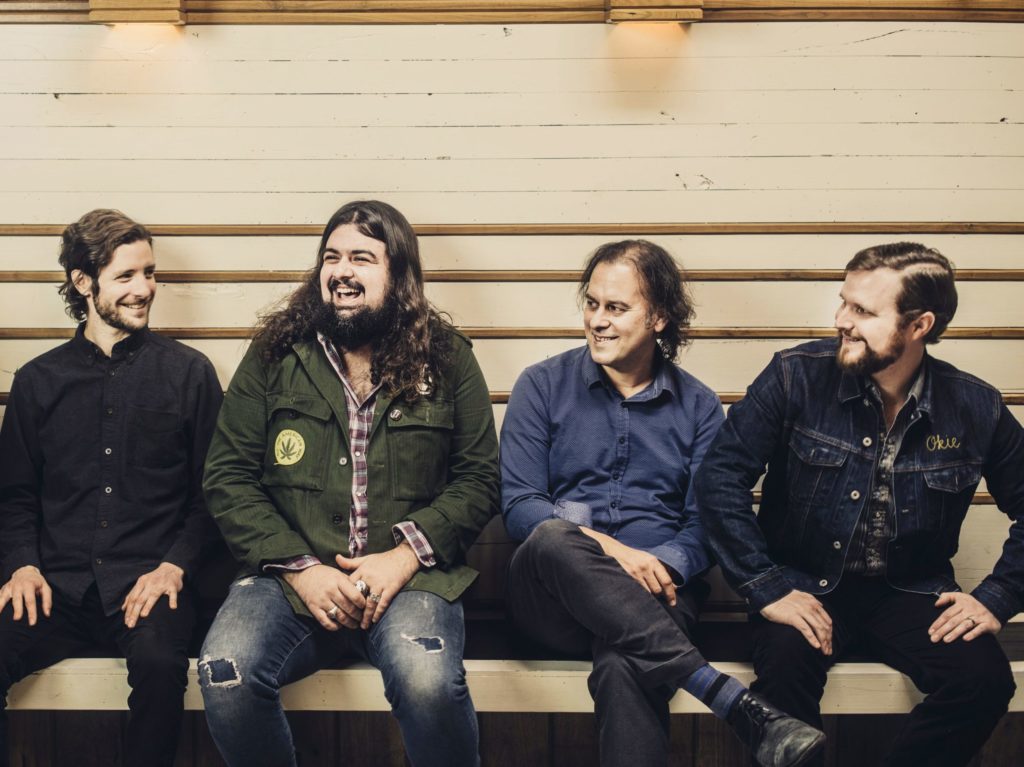
The National Reserve
For nearly half a decade, The National Reserve has spent its Friday nights lighting it up at a Brooklyn bar, winning over boozers and barflies with epic sets and a remarkable breadth of songcraft and showmanship. At present, with their stunning new Ramseur Records debut album, Motel LA GRANGE, the band has captured every bit of that energy, emotion, and entertainment for all to hear.
Founded and fronted by vocaliser-guitarist Sean Walsh, The National Reserve mine an archetypal musical seam, marrying gutbucket R&B, Laurel Canyon lyricism, New Orleans funk workouts, late nighttime soul, and bluesy, boozy rock 'northward' whorl to create their own timeless make of American music. Songs like "Institute Me A Woman" and the enduring title track reveal a gifted new tunesmith while masterfully reminding one and all of the simple beauty of a great American bar ring – two guitars, organ, bass and drums rocking out in the corner, singing their songs to soundtrack the nighttime.
The New Bailiwick of jersey-born Walsh began his musical journey amongst New Brunswick'southward all-ages house prove punk scene, a determinative experience that instilled his standing conventionalities in the ability of music to create customs. New inspiration came in the form of classic American artists like The Ring and Bob Dylan, whose rebellious, revolutionary spirit proved especially listen-bravado.
"When I heard BLONDE ON BLONDE," he says. "I thought this is way more than punk rock than annihilation I had ever heard."
Walsh began writing songs and relocated to Brooklyn where he put together the first iteration of The National Reserve. The band worked difficult, traveling constantly in an effort to both grow as artists and win over new fans.
In fourth dimension, Walsh eventually united the platonic National Reserve lineup he'd been working towards – guitarist Jon LaDeau, bassist Matthew Stoulil, keyboardist Steve Okonski, and drummer Brian Geltner. Having found his crack philharmonic, Walsh took The National Reserve off the road and began taking a more "quondam school approach" inspired by the paths taken by some of his greatest musical heroes.
"Look at The Band." Walsh says, "Guys like Taj Mahal and Leon Russell, they cut their teeth doing what we call residencies now only were just a gig back then. Y'all'd play three weeks at one order and then move on; play three weeks at the next society. You lot basically holed up somewhere and learned how to entertain people. And that, in my opinion, is something that has been lost."
The National Reserve settled into their new paradigm and began playing marathon weekly gigs at Brooklyn's Skinny Dennis in Williamsburg; four-hour sets that encompassed arcane R&B covers, classic rockers, and Walsh'due south own increasingly potent original songs.
"We've missed maybe ten of 'em," Walsh says. "Final time I did the math, nosotros had played close to a thousand hours, just at that 1 bar."
Week later on calendar week of hard performance strengthened The National Reserve into an unstoppable unit. Walsh'southward initial singer-songwriter approach merging with the ring'southward growing muscle to create a total-bodied rock 'n' coil that both warmed patrons' hearts only every bit information technology kept them moving on the tightly packed dance floor.
"I merely wanted to go good at playing music," Walsh says. "I wanted united states, every bit a band, to really learn how to communicate and learn the linguistic communication of playing music together. That was the first goal. And second, I wanted to learn how to be an entertainer. I looked at all the bands and artists that I loved, and they all understood that was their chore."
Walsh still appreciated that making great records was part of said gig and led The National Reserve through a number of studio visits, chipping abroad in Lexington, KY, Denver, CO, and Brooklyn over the past five years, recording and re-recording tracks determined to nail it downwardly beyond doubt.
"This group of songs is really important to me," he says, "then I kept coming back to it. I merely wanted to be certain we got information technology right."
Motel LA GRANGE truly came together in 2017, produced past Walsh at Brooklyn'south Studio G with the assist of longtime friend and collaborator, engineer Alexi Berthelot, and and then mixed in Lexington, KY past Duane Lundy (Jim James, Ringo Starr). Despite a few prior National Reserve recordings, Walsh sees the anthology as his ring's get-go. Indeed, the anthology spans Walsh'southward arc as both songwriter and bandleader, kick off with "No More," one of his earliest songs and still amid his favorites.
"It's one of the first songs I wrote where I thought, I've figured information technology out," he says. "We were never able to tape it properly though until now. I think I like my early songs better because I didn't intendance nigh annihilation back then, I was only writing any I felt similar writing. Every bit you motility on, you brainstorm to become these weird pretensions in your caput, but when you lot are merely starting out, you don't recall well-nigh people actually hearing what you're writing. That'southward a constant struggle, really."
Always determined to create a community, The National Reserve invited some of the innumerable friends they've made over the course of many, many Friday nights to bring together them in the studio, among them keyboardists Brian Mitchell (Levon Captain & The Midnight Ramble Band, Bob Dylan, BB King, Les Paul) and Brion Snyder, pedal steel guitarist Jonny Lam (Sinkane), percussionist Charlie Kessenich (Ensemble, et al.) and harmonicist Brian Hurd (Daddy Long Legs), with bankroll vocals contributed by Margo Valiante, Amanda Khiri (Sinkane), Kelli Scarr, and Alberta Cross' Petter Ericson Stakee, among others. Walsh fabricated certain the sessions caught fire by leading the ring in the studio only as if they were on phase, giving full life to tracks like the album-closing comprehend of "Roll On Babe" (written by Derroll Adams and and then fabricated famous by the one and only Ronnie Lane) as well every bit the righteous R&B burner, "Other Side of Dearest."
"We had no intention of recording information technology," Walsh says of the latter, "but right at the end of the very final session, we had most 20 minutes left and someone said, what about 'Other Side of Dearest'? We nailed information technology on the get-go take, just played it live, and equally we listened dorsum it really proved to me just how strong this ring is."
The National Reserve has now commenced their render to the road, eager to innovate audiences to Cabin LA GRANGE, though Walsh admits traditional touring has taken some readjustment.
"At outset, doing a regular xxx to 45 minute set was a bit of a challenge for united states of america," he says. "I can't actually plow on that fast. It takes us a couple of hours merely to really get started at present. So we've come up upwardly with a routine, we'll play in the dressing room for a fleck before the testify starts, just to warm up."
With Motel LA GRANGE, Walsh and The National Reserve have crafted a rich and raucous collection that instantly places them amid Americana's finest – its force, directness, and functioning non unlike some lost recording unearthed from the golden historic period of 70s rock 'n' curlicue. Justifiably proud of what he'southward accomplished, Walsh is now planning to bring all the fun and fire of The National Reserve's peppery Friday night sets to the residuum of the world, eager to pack as many folks into his band's late night scene every bit possible.
"Music is really powerful," says Sean Walsh. "It changed my life, which is why I do it. If I can reach people with our music, maybe change their life, that would really be incredible."
bensoncarring1978.blogspot.com
Source: https://mountaintownmusic.org/band/the-national-reserve/

ارسال یک نظر for "Off the Road Again Sean Walsh"